

Europe’s Appetite for Kenyan Avocados: Inside the Supply Chain Connecting Nairobi to Amsterdam
Introduction: The Rise of the Avocado Era
Walk into any supermarket in Amsterdam, Berlin, or Paris today, and you’ll find neatly stacked rows of avocados—perfectly ripened, dark-skinned, and ready for toast, salads, or smoothies. But have you ever paused mid-grocery run and wondered how that creamy green fruit made its way into your shopping basket? Chances are, it began its journey thousands of kilometers away, under the warm sun of central Kenya.
Over the past decade, avocados have evolved from a niche tropical fruit to a European staple. They’ve become the poster child of healthy eating, Instagram brunch culture, and plant-based diets. Yet behind that simple green fruit lies a sophisticated, carefully synchronized supply chain stretching from smallholder farms near Nairobi to advanced ripening centers in the Netherlands.
Kenya has quietly become one of Europe’s most important avocado suppliers. In fact, it now ranks among the top exporters globally, competing with giants like Mexico and Peru. What makes this even more fascinating is how efficiently this supply chain operates. Within weeks—sometimes even days—freshly harvested avocados are traveling in refrigerated containers across oceans, passing strict European quality standards, and landing on supermarket shelves.
This isn’t just a story about fruit. It’s a story about globalization, sustainability, economic growth, and the invisible threads that connect farmers in Murang’a to consumers in Amsterdam. It’s about precision timing, temperature control, and trust.
So let’s peel back the layers—literally and figuratively—and explore how Europe’s appetite for Kenyan avocados is reshaping agriculture, logistics, and trade between Nairobi and Amsterdam.
Why Europe Can’t Get Enough of Avocados
Europe’s love affair with avocados didn’t happen overnight. A decade ago, they were considered exotic—something you might find in specialty stores or high-end restaurants. Today? They’re mainstream. In some countries like the Netherlands and the UK, per capita avocado consumption has more than doubled in recent years.
Why this sudden obsession?
First, there’s the health factor. Europeans are increasingly health-conscious, scanning labels and prioritizing whole foods. Avocados tick every box: healthy fats, fiber, potassium, and vitamins. They’re often labeled a “superfood,” and whether that term is marketing hype or not, consumers have embraced it wholeheartedly.
Second, plant-based diets are booming. From flexitarians to full vegans, more Europeans are reducing meat consumption. Avocados offer creaminess and richness that make plant-based meals feel indulgent. Think about it—what’s a vegan burger without a thick slice of avocado? What’s a salad without that smooth, buttery texture?
Then there’s the cultural element. Social media has played a surprisingly powerful role. Avocado toast became symbolic of modern brunch culture. It’s photogenic, colorful, and aspirational. Food trends spread rapidly online, and avocados rode that wave straight into European kitchens.
Retailers have also leaned in. Supermarkets now stock “ready-to-eat” avocados, multipacks, organic options, and even pre-mashed guacamole. This convenience fuels demand even further.
But here’s the catch: Europe doesn’t produce enough avocados to meet this growing appetite. Southern Spain grows some, but not nearly enough. That supply gap creates opportunity—and Kenya has stepped up in a big way.
Why Kenya? The Perfect Avocado Climate
Kenya’s rise in the global avocado trade isn’t accidental. It’s geographical destiny meeting agricultural expertise.
The country sits near the equator, blessed with fertile volcanic soils and moderate temperatures in highland regions like Murang’a, Kiambu, and Nyeri. These conditions are almost tailor-made for avocado farming. Unlike regions that face extreme seasonal swings, Kenya enjoys relatively stable weather, allowing for consistent production cycles.
Rainfall patterns also favor avocado cultivation. The combination of two rainy seasons and well-drained soils ensures healthy tree growth and high-quality fruit development. Simply put, nature gives Kenyan farmers a head start.
But climate alone isn’t enough. The backbone of Kenya’s avocado industry is its network of smallholder farmers. Thousands of families cultivate avocados on small plots of land, often alongside tea, coffee, or maize. For many, avocados started as a secondary crop—something extra. Today, they’re a primary income source.
Government support and private investment have also played a role. Training programs teach farmers about pruning, pest management, and harvesting at the right maturity level. Export companies provide seedlings and technical guidance, aligning local practices with European standards.
In recent years, Kenya has even overtaken South Africa as Africa’s largest avocado exporter. That’s no small achievement.
So when you see a Kenyan avocado in Amsterdam, you’re looking at the result of ideal growing conditions, skilled farming communities, and a country that recognized opportunity and ran with it.
The Varieties Europe Loves: Hass and Fuerte
Not all avocados are created equal. If you’ve ever noticed the small sticker on your fruit, you’ve probably seen the word “Hass.” This variety dominates European shelves—and for good reason.
Hass avocados are prized for their creamy texture, rich flavor, and long shelf life. They start green and turn dark purple-black when ripe, making it easy for consumers to judge readiness. For retailers, that predictability is gold. It reduces waste and improves customer satisfaction.
Kenya primarily grows Hass for export. The trees are productive, and the fruit travels well over long distances. Considering that avocados journey from Nairobi to Amsterdam by sea—a trip that can take several weeks—durability matters.
Fuerte avocados, on the other hand, are larger and remain green even when ripe. They have a slightly lighter flavor and smoother skin. While still exported, they’re less dominant in European markets because consumers have grown accustomed to Hass.
Timing is everything in this business. Kenya’s main Hass season typically runs from March to September, which aligns strategically with European demand windows. This complements supply from Peru and other countries, ensuring supermarkets have year-round availability.
This careful coordination between variety selection and seasonal timing is what keeps European shelves stocked. It’s almost like a relay race—when one country’s harvest slows, another picks up the baton.
And Kenya? It has secured a strong position in that global rotation.
From Farm to Collection Center
The journey from tree to toast begins with a careful harvest. Unlike many fruits, avocados don’t ripen on the tree. They must be picked at the correct maturity level to ensure proper ripening later. Harvest too early, and they shrivel. Too late, and they spoil quickly.
Farmers use clippers to hand-pick each fruit, ensuring minimal damage. It’s labor-intensive work, often done under the hot sun. But precision here determines everything that follows.
After harvesting, avocados are placed in crates—not sacks—to avoid bruising. They’re transported to collection centers, usually operated by export companies. Here’s where the first serious quality checks begin.
At these centers, staff inspect the fruit for size, weight, and external defects. European markets have strict standards. A single pest mark or irregular shape can disqualify fruit from export grade. Those that don’t make the cut are sold locally.
This stage is critical because it links small-scale farmers to global markets. Collection centers act as aggregators, combining produce from hundreds of farms into export-ready volumes.
Think of it as the first checkpoint in a long international relay. If something goes wrong here, it echoes all the way to Amsterdam.
But when done right, it sets the stage for a seamless cold-chain journey across continents.
Sorting, Grading, and Packaging
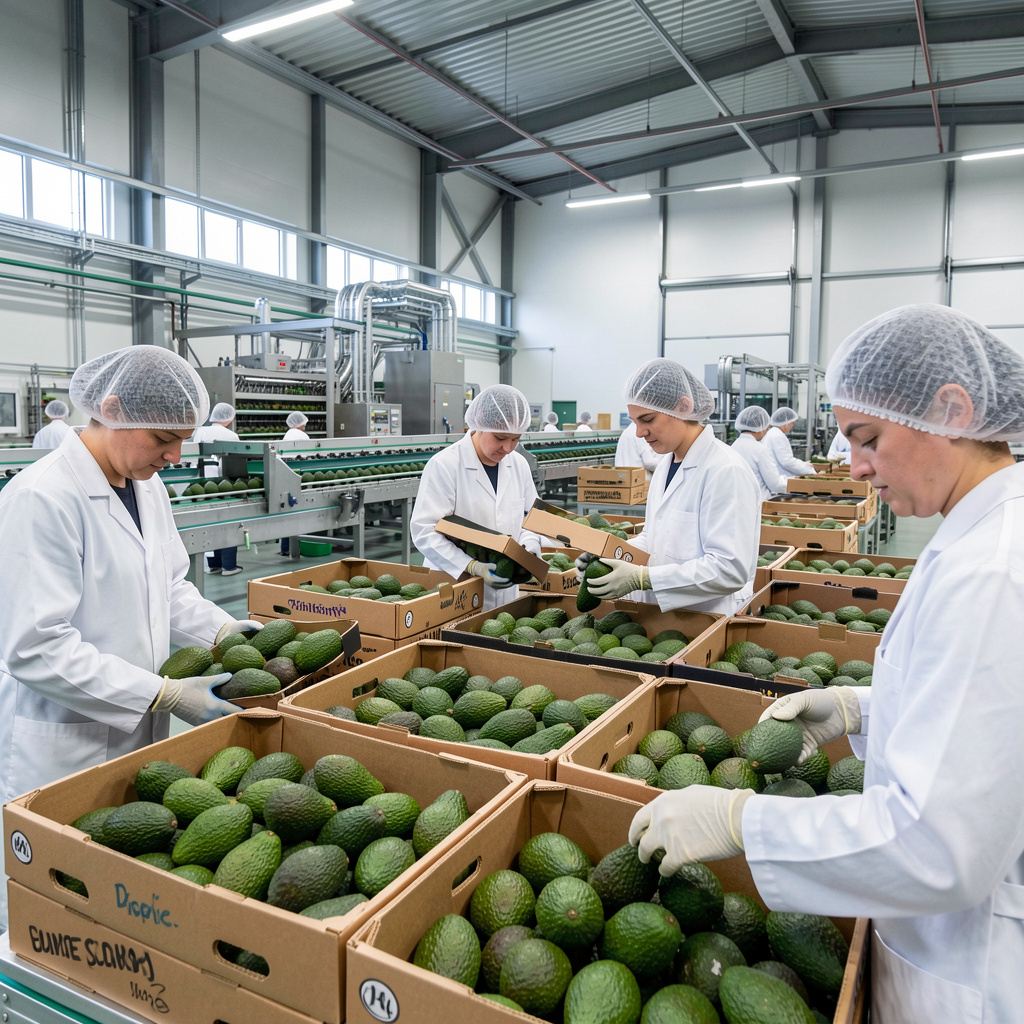
Once the avocados arrive at the packhouse from various collection centers, the real transformation begins. If the farm is where the story starts, the packhouse is where it becomes global. Here, the fruit shifts from being a local harvest to an export-ready product destined for European supermarket shelves.
The first step is sorting and grading. Workers carefully place avocados onto conveyor belts where they’re washed and dried. Dust, sap, and field residue are removed to ensure cleanliness. Then comes grading—arguably one of the most important stages in the supply chain.
European buyers demand uniformity. That means avocados are sorted based on:
- Size (measured by count per carton)
- Weight
- External appearance
- Absence of pests or blemishes
- Firmness and maturity level
Modern packhouses often use optical sorting machines equipped with cameras and sensors. These machines can detect subtle imperfections invisible to the human eye. It’s fascinating—technology scanning fruit grown on small rural farms, all to meet a shopper’s expectation in Amsterdam.
Once graded, the avocados are packed into standardized cartons, typically 4kg boxes. Labels are added with traceability codes. These codes allow European retailers to trace each batch back to the specific farm or region in Kenya. In today’s food industry, traceability isn’t optional—it’s essential.
Certifications also matter here. Many exporters hold:
- GlobalG.A.P. certification
- Fairtrade certification
- Organic certification (where applicable)
- Rainforest Alliance accreditation
These labels signal trust. They tell European consumers that the fruit meets safety, environmental, and ethical standards.
Packaging isn’t just about aesthetics. It’s about protection. Cartons are designed to allow airflow, preventing heat buildup during transport. A single weak box could collapse under stacking pressure inside a shipping container, damaging hundreds of avocados.
By the time the cartons are sealed, stacked, and palletized, the fruit is no longer just produce—it’s a precisely calibrated export commodity ready for its cold-chain journey.
Cold Chain Logistics: Keeping It Fresh
If there’s one hero in this entire supply chain, it’s the cold chain. Without strict temperature control, Kenyan avocados would never survive the journey to Europe.
Avocados must be kept at specific temperatures—usually between 5°C and 7°C—depending on their maturity stage. Too cold, and they suffer chilling injury. Too warm, and they ripen prematurely. It’s a delicate balance, like walking a tightrope across the Indian Ocean.
The process starts with pre-cooling. As soon as avocados are packed, they’re moved into cold rooms where field heat is rapidly removed. This step slows down respiration—the natural process that causes fruit to ripen and age.
Next, the pallets are loaded into refrigerated trucks, often called reefer trucks, which transport them to the Port of Mombasa. These trucks are temperature-monitored in real time. Even minor fluctuations can trigger alerts.
At the port, the fruit is transferred into refrigerated shipping containers—massive metal boxes equipped with built-in cooling systems. These containers maintain consistent airflow and humidity levels throughout the voyage.
Here’s what makes it remarkable:
| Stage | Temperature Control | Risk if Uncontrolled |
|---|---|---|
| Farm Harvest | Ambient | Rapid spoilage |
| Pre-Cooling | 5–7°C | Uneven ripening |
| Reefer Truck | Constant cooling | Bruising & heat damage |
| Sea Transport | Controlled atmosphere | Loss of firmness |
Some containers even use controlled atmosphere technology, adjusting oxygen and carbon dioxide levels to slow ripening further. It’s almost like putting the avocados to sleep for their long trip.
Without this invisible refrigeration network, Europe’s avocado shelves would be empty. Cold chain logistics isn’t glamorous, but it’s absolutely essential.
The Port of Mombasa: Kenya’s Export Gateway
The Port of Mombasa is where Kenya meets the world. It’s busy, noisy, and constantly in motion. Cranes lift containers like toys, ships line the docks, and logistics teams coordinate around the clock.
For avocado exporters, this port is the final Kenyan checkpoint.
Once reefer containers arrive at the port, they’re plugged into power sources to maintain cooling. Port officials inspect documentation, including:
- Phytosanitary certificates
- Export permits
- Certificates of origin
- Quality inspection approvals
The Kenya Plant Health Inspectorate Service (KEPHIS) plays a major role here. They ensure that shipments comply with European Union regulations. Any signs of pests or disease can halt an entire consignment.
After clearance, containers are loaded onto cargo vessels bound for Europe. Most shipments travel via major shipping lines that connect Mombasa to Rotterdam—the largest port in Europe.
The sea journey typically takes about 20 to 30 days, depending on routing and transshipment stops. During this time, shipping companies continuously monitor container conditions remotely.
It’s incredible to think about: while consumers in Amsterdam go about their daily routines, thousands of avocados are quietly crossing the Suez Canal, perfectly chilled and protected inside steel containers.
Mombasa isn’t just a port—it’s the heartbeat of Kenya’s export economy.
Sea Freight vs. Air Freight
When it comes to transporting avocados to Europe, exporters have two main options: sea freight or air freight. But in reality, sea freight dominates.
Why?
Cost.
Shipping by air is dramatically faster—avocados can reach Europe in less than 48 hours. But it’s also significantly more expensive. Air freight is typically reserved for:
- Premium orders
- Urgent shipments
- High-value niche markets
Sea freight, on the other hand, is cost-effective and suitable for large volumes. Since avocados are hardy and can be stored under controlled temperatures, they’re ideal candidates for ocean transport.
Here’s a simple comparison:
| Factor | Sea Freight | Air Freight |
|---|---|---|
| Transit Time | 20–30 days | 1–3 days |
| Cost | Low | High |
| Carbon Footprint | Lower per kg | Much higher |
| Volume Capacity | Very high | Limited |
There’s also a sustainability angle. European consumers increasingly care about carbon emissions. Shipping by sea produces significantly fewer emissions per kilogram compared to air transport. For eco-conscious retailers, this matters.
So while air freight offers speed, sea freight offers scalability and affordability. For Kenyan avocados heading to Amsterdam, the ocean route wins most of the time.
Arrival at the Port of Rotterdam and Amsterdam
After weeks at sea, the ship docks at the Port of Rotterdam. This port is Europe’s logistical giant—efficient, automated, and deeply integrated into continental supply chains.
The containers are unloaded and immediately plugged into power sources to maintain cooling. Customs clearance begins. Dutch authorities inspect documentation and may conduct random physical inspections.
The European Union enforces strict phytosanitary rules. Officials check for:
- Pests
- Residue levels
- Proper certification
- Compliance with EU marketing standards
Only after passing inspection can the avocados enter the European market.
From Rotterdam, many shipments move to distribution centers around Amsterdam. The Netherlands serves as a re-export hub, meaning avocados arriving here may later travel to Germany, France, Scandinavia, and beyond.
It’s fascinating how a fruit grown in central Kenya often lands first in the Netherlands before spreading across Europe. Amsterdam isn’t just a destination—it’s a gateway.
Ripening Centers in the Netherlands
Here’s something most consumers don’t realize: avocados arriving in Europe are usually still hard.
Ripening happens in specialized facilities called ripening centers.
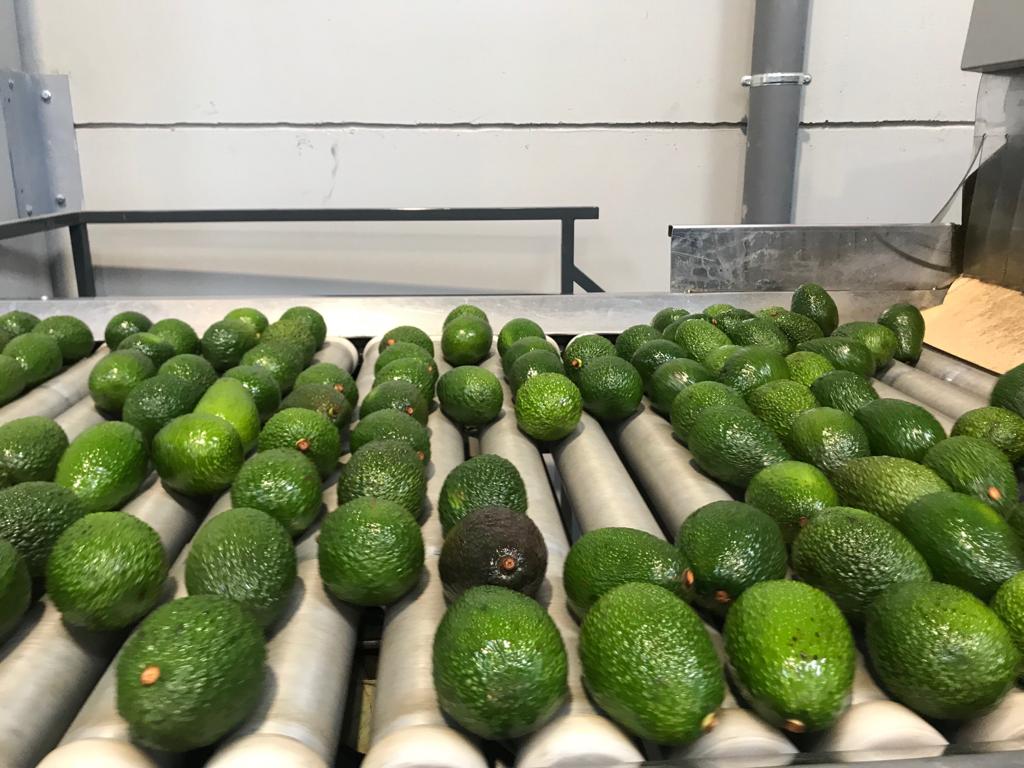
These centers use controlled environments where temperature, humidity, and ethylene gas levels are carefully adjusted. Ethylene is a natural plant hormone that triggers ripening. By controlling exposure, operators can ensure avocados ripen evenly.
Why not let them ripen naturally?
Because supermarkets want precision. They need “ready-to-eat” fruit available exactly when shoppers expect it.
The ripening process typically takes 4 to 7 days. Afterward, avocados are redistributed to supermarkets across Europe.
This final stage ensures that when a shopper in Amsterdam gently squeezes an avocado, it yields perfectly. That softness isn’t luck—it’s science.
Sustainability in the Supply Chain
Avocados have faced criticism in global markets—water use, deforestation concerns, and carbon emissions are often debated.
Kenya’s avocado industry is increasingly responding with sustainability measures:
- Drip irrigation systems to conserve water
- Agroforestry practices
- Solar-powered packhouses
- Reduced pesticide usage
European buyers demand sustainability audits. Fairtrade programs ensure farmers receive fair compensation.
There’s also growing investment in carbon footprint tracking. Some exporters now calculate emissions per shipment, aiming to reduce environmental impact.
Sustainability isn’t just marketing anymore—it’s a business requirement.
Challenges Facing the Trade
Despite its success, the Kenya–Europe avocado corridor faces real challenges.
Climate change is unpredictable. Irregular rainfall can disrupt flowering and harvest cycles.
Market competition is intense. Peru, Colombia, and Mexico all compete for European shelf space.
Price volatility can squeeze farmers. A bumper harvest in one region can push global prices down.
Then there are regulatory shifts. The EU frequently updates pesticide residue limits and import rules. Exporters must adapt quickly.
This trade route is profitable—but it’s not simple.
The Economic Impact on Kenyan Farmers
For many Kenyan farmers, avocados have transformed livelihoods.
In regions like Murang’a, avocado income has funded:
- School fees
- Healthcare
- Home improvements
- Farm expansion
Export contracts provide more stable earnings compared to local markets.
Government agencies have supported this growth by improving rural roads, offering training, and negotiating trade agreements.
Avocados have become more than a crop—they’re an economic lifeline.
The Future of the Kenya–Europe Avocado Corridor
The future looks promising.
Blockchain-based traceability systems are emerging, allowing European buyers to scan QR codes and see exactly where fruit was grown.
Demand in Eastern Europe is rising, expanding beyond traditional markets.
Kenya is also exploring value addition—producing avocado oil and processed products.
If logistics efficiency continues improving, this corridor could grow even stronger.
Conclusion
Europe’s appetite for Kenyan avocados is more than a food trend—it’s a sophisticated global partnership. From smallholder farms near Nairobi to ripening centers in Amsterdam, the journey is powered by precision, technology, and trust.
Every avocado represents thousands of hands working together—farmers, packers, logistics teams, inspectors, and retailers.
Next time you slice one open, remember: you’re tasting a story that traveled thousands of kilometers to reach your plate.
FAQs
1. How long does it take for Kenyan avocados to reach Europe?
Typically between 20 and 30 days by sea, depending on shipping routes.
2. Why are most avocados in Europe the Hass variety?
Hass avocados have a longer shelf life, richer flavor, and predictable ripening behavior.
3. Does Kenya export avocados year-round?
Kenya has a strong main season from March to September, with smaller off-season volumes.
4. Are Kenyan avocados sustainably produced?
Many exporters follow GlobalG.A.P. and Fairtrade standards, with increasing focus on water conservation and environmental practices.
5. Why do avocados arrive hard in Europe?
They are intentionally shipped unripe to prevent spoilage and are later ripened in controlled facilities.


Add a comment